LiFePO4 charging guide: voltages, phases and practical rules
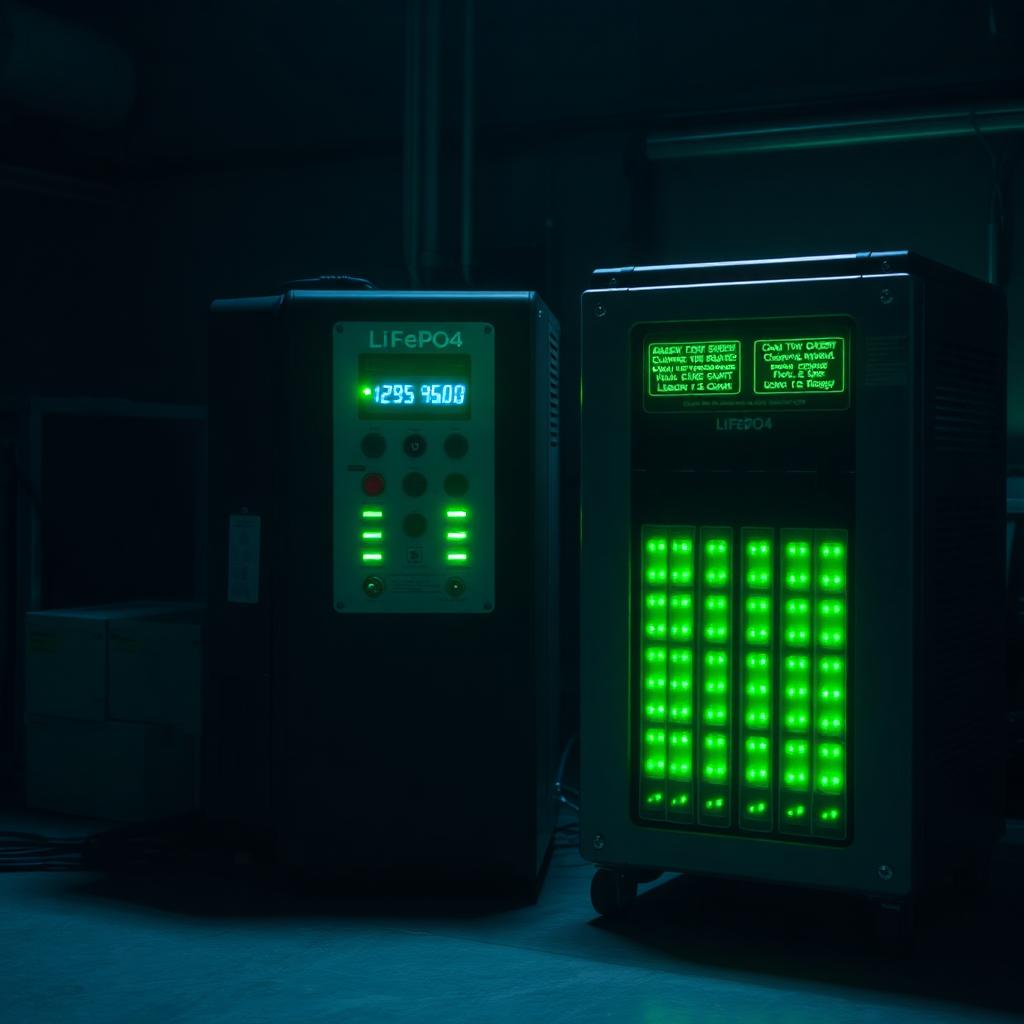
How to correctly charge an industrial LiFePO4 battery — phase by phase, in plain language.
A LiFePO4 (lithium iron phosphate) battery behaves very differently under charge from a familiar lead-acid pack. A poorly configured charger can strip years of service life from a pack in a short time — while a well-parameterised charge profile keeps capacity intact for thousands of cycles. This guide summarises the key rules for industrial cleaning-machine and fleet operators.
Cell voltage basics. A LiFePO4 cell has a nominal voltage of 3.2 V, sits at 3.55–3.65 V fully charged and around 2.5 V fully discharged. This builds up into the system voltage: a 12 V pack contains 4 cells in series, a 24 V pack 8, a 36 V pack 12 and a 48 V pack 16. The charger must always be sized to the full pack — and to the upper charging voltage, not the nominal one.
The three charging phases. 1) Bulk (constant current — CC): the charger delivers its maximum permitted current until the pack reaches the absorption voltage. Roughly 80–90% of the energy is transferred in this phase. 2) Absorption (constant voltage — CV): voltage is held constant while the current tapers off as the cells top up. 3) Float: unlike lead-acid, LiFePO4 does not need a sustained float charge. Either float is skipped entirely, or it is set very low (around 13.6 V on a 12 V pack) so it does not stress the cells.
Typical voltage settings. For a 12 V system the absorption voltage is usually 14.2–14.6 V, with float (if used) around 13.6 V. Double those figures for a 24 V system (28.4–29.2 V absorption, 27.2 V float); 42.6–43.8 V / 40.8 V for 36 V; and 56.8–58.4 V / 54.4 V for 48 V. The exact values are always defined by the battery datasheet — these are only indicative ranges.
Charging current. Most manufacturers allow LiFePO4 to be charged at up to 0.5C (half the rated capacity as current) without any issue, and many cells accept 1C. A 100 Ah pack can therefore be safely charged at 50 A, and often at 100 A. In industrial cleaning machines the practical range is usually 0.2–0.5C: fast enough to add meaningful charge during a lunch break, gentle on the cabling and the BMS.
Temperature — the most common mistake. LiFePO4 cells must NOT be charged below 0 °C: doing so causes lithium plating, which is an irreversible loss of capacity and a serious internal short-circuit risk. The BMS in LFP-E packs blocks this automatically, but operators should still know: if the machine has been working in a cold store or a winter loading bay, let it warm up before charging. The discharge window is wider (–20 °C to +55 °C), but for charging the ideal range is +5 °C to +45 °C.
Opportunity charging. Unlike lead-acid, LiFePO4 does not need to be run flat and then charged to 100% to stay “healthy”. In fact life is longest when the pack cycles between roughly 20% and 90% and gets plugged in during short breaks in the shift (lunch, changeover). A 30-minute break can put back 25–30% of the capacity, with no memory effect and no accelerated ageing.
Storage. When a machine sits idle for longer periods (e.g. off-season), store the LiFePO4 pack at around 50–60% state of charge, in a dry location between 0 and 25 °C. A top-up charge every 3–6 months is recommended. Leaving the pack fully charged or fully discharged for weeks or months is equally damaging.
Charger compatibility. A conventional lead-acid charger runs an equalisation cycle that pulses as high as 15.5–16 V on a 12 V system — enough to damage a LiFePO4 pack immediately. Always use a LiFePO4-compatible charger, or a multi-profile charger with an explicit “LiFePO4” / “Lithium Iron Phosphate” programme. The word “lithium” on its own is not enough — Li-ion (NMC) profiles exist too and are tuned to different voltages.
What the BMS handles for you. Inside every LFP-E pack the BMS automatically: cuts off on over-voltage, blocks sub-zero charging, balances cells at the end of the absorption phase and disconnects before deep discharge. Even so, setting the charger correctly remains the operator’s responsibility — the BMS is a safety net, not a replacement.
In summary: use a charger tuned for LiFePO4, respect the datasheet voltages, do not force a float phase, plug in freely during shifts, and mind the temperature. Follow these rules and the LFP-E pack will actually deliver the promised 6,000+ cycles in your fleet. If you are unsure whether your existing charger is compatible, request a free technical assessment from our engineers.